
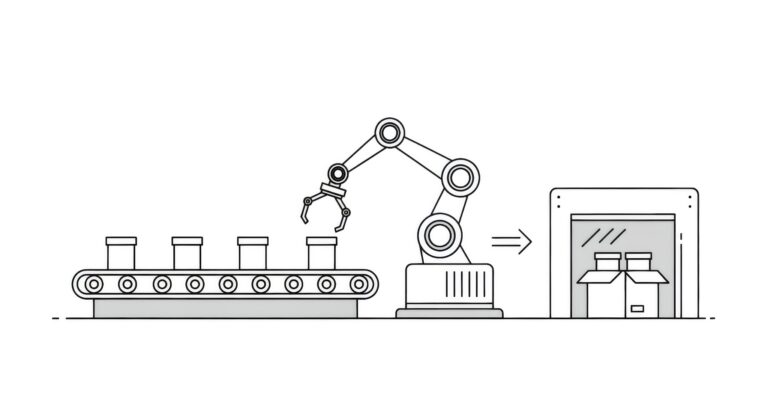
Why Invest in a Pick and Place Robot?
Manufacturers face constant pressure to reduce costs, increase production, and maintain high precision. A pick-and-place robot delivers on all fronts and is a core element of modern robotic automation solutions.
This guide covers the key benefits of a robotic pick-and-place system. It also discusses standard setups and the steps to implement the system. Finally, it outlines how to measure success.
What Is a Pick and Place Robot?
A pick-and-place robot is a type of industrial robot. It grips parts, like circuit board components or bulk items, and moves them with high precision. In real time, advanced vision systems identify part location and orientation. The robot arm tool then lifts, translates, and places items accurately into position, improving quality control and throughput.
Key points:
- Robotic pick and place system combines robotic arms, end-effectors, controls, and sensors.
- Operation on an assembly line reduces repetitive tasks for human workers.
- Integration of machine learning in vision helps adapt to part variation.
Core Benefits of Robotic Automation Solutions
Cost Effectiveness
- Labor savings: One pick and place robot often replaces two to three FTEs.
- Lower waste: High precision cuts scrap and rework.
- Energy efficiency: Robot systems idle at minimal power.
Increased Production
- 24/7 operation: Robots run nonstop, boosting units per shift.
- Consistent cycle times: No fatigue or breaks means steady throughput.
- Scalable cells: Add more robot systems as volume grows.
High Precision & Quality Control
- Placement accuracy down to 0.1 mm on a circuit board.
- Inline inspection: Advanced vision systems catch defects immediately.
- Traceability: Data logs every pick for audits.
Safer Work Environment
- Ergonomics: Robots handle heavy loads, reducing injury risk.
- Collaborative robots: Cobots operate safely alongside human operators without full guarding.
Common Pick and Place Configurations
| Robot Type | Axes | Typical Use Case |
|---|---|---|
| Cartesian | 3 (X-Y-Z) | Straight-line moves, machine tending |
| SCARA | 4 | Fast horizontal picks, electronics assembly |
| Delta | 3 | High-speed packaging, bin picking |
| Articulated Arm | 6+ | Complex 3D motion, palletizing |
- 2-axis pick and place robot: Budget entry for simple back-and-forth moves.
- 3-axis pick and place robot: Adds vertical reach for stacking trays.
- High-speed pick and place robot: Achieves 200+ picks per minute in bottling or pharma lines.
Implementation Roadmap
Define Requirements
- Throughput target: Units per minute to increase production.
- Part specs: Weight, size, and placement tolerance.
Cell Layout & Safety
- Map conveyors, feeders, and buffer zones.
- Plan fencing or use collaborative robots for mixed-use areas.
- Include emergency stops and lock-out/tag-out points.
Select End-Effectors
- Vacuum cups for smooth parts.
- Two-finger grippers for rigid components.
- Bin picking tools for random orientation of bulk parts.
Integrate Vision & Controls
- Mount advanced vision systems over the cell for real-time part detection.
- Connect the robot controller to your PLC or MES network.
- Employ machine learning routines to improve recognition accuracy over time.
Test & Tune
- Run pilot batches on your product line.
- Adjust grip force, motion speed, and camera thresholds.
- Track uptime, cycle time, and defect rate.
Train & Maintain
- Operator training on jam clearing, part reload, and error reset.
- Preventive maintenance on joints, belts, and filters.
- Review performance logs monthly to spot wear or drift.
Cost Comparison: Robots vs. Manual Labor
| Cost Element | Robot (Year 1) | Robot (Years 2–5) | Manual Labor (Annual) |
|---|---|---|---|
| Capital Expense | $75,000 | $0 | $0 |
| Maintenance (5%) | $3,750 | $3,750 | $0 |
| Power & Consumables | $1,200 | $1,200 | $0 |
| Labor Wages | $0 | $0 | $50,000 |
| Training & Recruit | $0 | $0 | $5,000 |
| Total | $79,950 | $4,950 | $55,000 |
A pick and place robot cell can cost about $100,000 over five years. In contrast, manual labor costs $275,000. This means a 64% savings. This does not include any quality improvements or higher production rates.
Measuring Success
Track these metrics to confirm ROI:
- Cycle time: Compare against manual picks.
- Uptime %: Aim above 95% for critical cells.
- Defect rate: Target under 0.5% with inline inspection.
- Production increase: Units per shift before vs. after.
Conclusion
Pick-and-place robots are the heart of modern robotic assembly systems. They deliver cost effectiveness, increase production, and ensure high precision in manufacturing processes. From circuit board assembly to bulk bin picking, a well-chosen robotic pick-and-place system transforms your product line.
Ready to explore? Contact Ubiros for a free consultation and pilot proposal.